Frequently Asked Questions
The most-asked questions about polymers and macromolecules.
What exactly is a polymer or macromolecule?
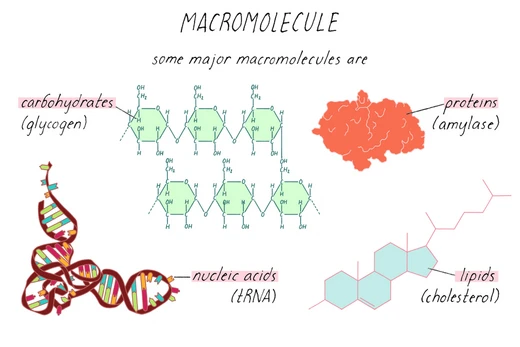
A polymer is a giant molecule assembled by linking thousands to millions of smaller repeating units called monomers into long chains or three-dimensional networks. The term 'macromolecule' is essentially a synonym that emphasizes the large molecular weight relative to ordinary small-molecule compounds.
Who are the main figures in polymer science history?
Julius Staudinger is widely credited with proposing in the 1920s that monomers form true covalent chains, while Wallace Carothers at DuPont synthesized the first nylon in 1935. Paul Flory later earned a Nobel Prize in 1974 for his statistical theories of polymer structure and reaction kinetics.
Where should a newcomer start learning about polymers?
Begin with monomer chemistry and the two core polymerization mechanisms—addition (chain-growth) and condensation (step-growth)—since nearly every material story builds on those two pathways. From there, exploring how chain length, branching, and cross-linking dictate bulk properties gives you the structural framework for everything else.
What are the key types or 'factions' within the polymer world?
Polymers are commonly grouped into thermoplastics (re-meltable, like polyethylene), thermosets (permanently cross-linked, like epoxy resins), and elastomers (highly stretchy, like natural rubber). Natural polymers such as cellulose, proteins, and nucleic acids form a parallel category alongside the synthetic ones.
What is a monomer, and why is it central to the story?
A monomer is the small repeating unit—often just a few atoms bearing a reactive double bond or functional group—that links to its neighbors to build the full polymer chain. Without monomers there is no polymer; they are the fundamental building blocks that get assembled into the larger structure.
What is a landmark 'notable moment' in polymer history?
The 1935 isolation of nylon 6,6 at DuPont is often cited as the moment synthetic polymers entered the mainstream, replacing silk in stockings and parachutes. Another pivotal milestone was Carothers's 1932 work on polyurethane precursors, which opened the door to an enormous family of coatings, foams, and adhesives.
How do polymer properties differ from those of small-molecule materials?
Because polymer chains are long and entangled, they can be simultaneously flexible, tough, and highly viscous in ways small molecules cannot replicate. Properties like glass transition temperature, melting point, and tensile strength depend heavily on chain length, tacticity, and degree of crystallinity rather than a single molecular formula.
What is the difference between addition and condensation polymerization?
Addition polymerization (for example, ethylene to polyethylene) links monomers through reactive double bonds without losing any small by-product. Condensation polymerization (for example, a diamine reacting with a diacid to make nylon) joins monomers while eliminating a small molecule such as water or HCl at each new bond.
Why are polymers so dominant in modern materials?
Their long-chain architecture lets chemists tune stiffness, elasticity, solubility, and electrical behavior simply by changing the monomer, chain length, or cross-link density. This design flexibility, combined with low cost and ease of processing, makes polymers the backbone of packaging, textiles, medicine, and electronics.
What is the most hotly debated frontier topic in the polymer community?
Biodegradable and bio-based polymers—such as polylactic acid (PLA) and polyhydroxyalkanoates (PHA)—are at the center of ongoing research as scientists race to replace petroleum-derived plastics with materials that microbes can break down. Equally prominent is the push toward truly recyclable thermosets and circular-economy processing methods.