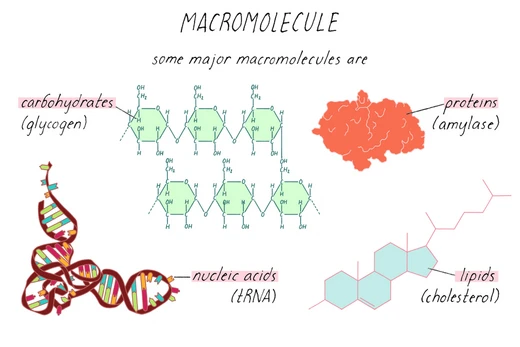
Macromolecule
Molecules of high relative molecular mass with repeating structural units.

A macromolecule is a molecule of high relative molecular mass, the structure of which essentially comprises the multiple repetition of units derived, actually or conceptually, from molecules of low relative molecular mass. Polymers, often used in many consumer goods, are examples of macromolecules. Common macromolecules include biopolymers (RNA and DNA, proteins, and carbohydrates), polyolefins (polyethylene), and polyamides (nylon).
- field
- Chemistry, Biochemistry, Materials Science
- known_for
- High relative molecular mass; composed of repeating subunits; includes synthetic polymers and natural biopolymers
Lore & Background
Macromolecules encompass both synthetic and natural forms. Synthetic macromolecules include thermoplastics, thermosets, dendrimers, vitrimers, covalent organic frameworks, and, when considering organometallic materials, metal organic frameworks. Non-covalent bonding such as hydrogen bonds or pi-stacking also yields supramolecular networks. In nature, proteins are polymers of amino acids joined by peptide bonds; DNA and RNA are polymers of nucleotides joined by phosphodiester bonds; polysaccharides such as starch, cellulose, and chitin are polymers of monosaccharides joined by glycosidic bonds. Lipids, while essential to life, are not considered macromolecules under the IUPAC definition, as they are not polymers of repeating subunits. Many living organisms depend on three essential biopolymers: DNA, RNA, and proteins. However, some viruses (e.g., RNA viruses) rely only on RNA and proteins, and not all organisms use DNA as their genetic material. DNA encodes genetic information and is optimized for stability and repair. Proteins catalyze biochemical reactions and carry out organismal functions. RNA is multifunctional, encoding proteins and folding into catalytic structures, though it is less stable than DNA.
Reader's Guide
Macromolecules are fundamental to both synthetic materials and biological systems. Synthetic macromolecules, such as polyethylene produced on a large scale, form the basis of plastics, synthetic fibers, and rubber. In nature, biopolymers like DNA, RNA, and proteins are essential for life: DNA stores genetic information, RNA translates it, and proteins catalyze reactions and perform cellular functions. Polysaccharides serve as energy stores and structural components, while lignin provides structural support in trees. The study of macromolecules bridges chemistry, biology, and materials science, enabling advances in medicine, manufacturing, and understanding of life itself.
Did You Know?
- Polyethylene is produced on such a large scale that ethylene is one of the most important monomers in the chemical industry, though other chemicals like ammonia or sulfuric acid are also top products by volume.
- DNA has three primary attributes that make it better than RNA at encoding genetic information: double-strandedness, greater stability due to absence of 2'-hydroxyl group, and sophisticated repair systems.
- Proteins are composed of 20 or more different amino acid building blocks, allowing them to fold into a vast number of three-dimensional shapes.
- Lignin comprises about a third of the mass of trees and arises primarily by radical polymerization (oxidative coupling) of monolignols.
Defining the Macromolecular World
A macromolecule is fundamentally a large-scale molecular architecture built from the repeated assembly of smaller building blocks. Rather than existing as a single isolated unit, its structure is defined by the multiple repetition of subunits that are themselves derived from molecules of low relative molecular mass. This principle of repetition gives rise to polymers, which permeate both the natural and manufactured worlds. In nature, the most familiar macromolecules include biopolymers such as DNA, RNA, proteins, and carbohydrates, alongside polyolefins like polyethylene and polyamides such as nylon. The category extends well beyond these well-known examples. When synthetic chemistry enters the picture, the family broadens to encompass thermoplastic and thermoset polymers, dendrimers, vitrimers known as covalent adaptable networks, and covalent organic frameworks. If organometallic materials are included, metal-organic frameworks join the list, and when non-covalent interactions like hydrogen bonding or pi-stacking are considered, an even wider universe of supramolecular networks falls under the macromolecular umbrella.
The Molecular Grammar of Life
Every living organism depends on three essential biopolymers—DNA, RNA, and proteins—each playing a distinct and indispensable role in cellular function. The elegant summary of their relationship is that DNA produces RNA, and RNA in turn produces proteins. All three share a common architectural logic: they are unbranched, linear polymers composed of repeating monomeric units linked by covalent bonds, much like beads strung along a long thread. Proteins are chains of amino acids connected through peptide bonds. DNA and RNA are chains of nucleotides joined by phosphodiester bonds, where each nucleotide carries a phosphate group, a sugar (deoxyribose in DNA, ribose in RNA), and one of five nitrogenous bases—adenine, guanine, cytosine, thymine (DNA only), or uracil (RNA only). Polysaccharides like starch, cellulose, and chitin represent yet another class, built from monosaccharides linked by glycosidic bonds. Within these chains, monomers have a strong tendency to interact with one another, producing Watson-Crick base pairing in nucleic acids and complex folding patterns in proteins and RNA.
Synthetic Macromolecules and Industrial Dominance
While nature produces its own remarkable macromolecules, human industry has developed an enormous array of synthetic polymers that underpin modern material culture. Plastics, synthetic fibers, and synthetic rubber represent the most visible categories, but the chemical taxonomy is far richer. Polyethylene stands out as a production giant: it is manufactured on such a massive scale that ethylenes constitute the primary product of the entire chemical industry. Beyond this flagship example, synthetic macromolecules span thermoplastic polymers that can be melted and reshaped, thermoset polymers that lock into permanent cross-linked structures, and dendrimers with their highly branched architectures. More recent innovations include vitrimers, also called covalent adaptable networks, which allow dynamic bond rearrangement, and covalent organic frameworks that create porous crystalline structures. When the scope expands to organometallic chemistry, metal-organic frameworks enter the picture, and when non-covalent forces such as hydrogen bonds and pi-stacking interactions are factored in, a vast landscape of supramolecular networks becomes part of the macromolecular family.
Three Specializations, One Living System
The three essential biopolymers are not interchangeable; each is optimized for a fundamentally different biological task. DNA serves as the information archive, encoding the complete genomic instructions needed to assemble, maintain, and reproduce every organism. Its superiority as an information carrier rests on three attributes: it is typically double-stranded, providing two redundant copies of each gene; it is chemically more stable than RNA, largely because it lacks the 2'-hydroxyl group present in every RNA nucleotide; and it is protected by sophisticated surveillance and repair machinery that monitors and corrects damage. No analogous repair system exists for RNA. Proteins, by contrast, are the workhorses of cellular chemistry. Their single-stranded nature and the chemical diversity of twenty or more amino acid types allow them to fold into an enormous variety of three-dimensional shapes, creating specific binding pockets and enabling enzymatic catalysis of virtually every biochemical reaction that sustains life—from photosynthesis to neural signaling to muscle movement. RNA occupies a multifunctional middle ground, translating genetic instructions into protein sequences while also regulating protein synthesis in eukaryotic cells.
Frequently Asked Questions
What is a macromolecule in simple terms?
A macromolecule is a very large molecule assembled from many small, repeating building blocks, which gives it a high relative molecular mass. You can picture it as a long chain where the same or similar subunits are linked over and over.
What are the main categories of macromolecules?
They fall into two broad groups: natural biopolymers such as DNA, RNA, proteins, and carbohydrates, and synthetic polymers like polyethylene and nylon. Both share the defining trait of being built from repeating structural subunits.
How is a macromolecule different from a regular small molecule?
The distinction comes down to scale and repetition: a macromolecule is constructed from numerous low-mass units joined together, while a small molecule contains only a handful of atoms. That extensive repetition is what produces the high molecular weight characteristic of macromolecules.
Which scientific fields study macromolecules?
Chemistry, biochemistry, and materials science all examine macromolecules, each emphasizing different angles such as biological function, molecular structure, or engineering applications. The topic naturally bridges natural and synthetic systems.
Why do macromolecules matter in everyday life?
They underpin countless consumer products, from the polyethylene in a phone case to the nylon in a jacket. In the body, biopolymers like DNA and proteins are the very molecules that store genetic information and drive cellular processes.
More in Polymers And Macromolecules 1-24
Elsewhere in the Polymers And Macromolecules universe
Spotted an error? Know more?
This is a living reference — every entry is fact-audited, and reader corrections feed straight into our audit queue. Suggest an edit · See this site's audit record