Polyethylene
Polyethylene is the most commonly produced plastic worldwide.

Polyethylene (PE) is the most commonly produced plastic, a polymer primarily used for packaging such as plastic bags, films, geomembranes, and containers. Its properties include being nontoxic, chemically resilient, and combustible, but its chemical resilience also makes it a long-lived pollutant when disposed of improperly.
- field
- Polymer chemistry
- common_name
- Polyethylene or polythene
- known_for
- Most commonly produced plastic, used in packaging and insulation
Lore & Background
During World War II, polyethylene's low-loss properties at high-frequency radio waves made it crucial for insulating coaxial cables in radar sets, and commercial distribution was suspended.
Reader's Guide
Polyethylene's significance lies in its dominance as the most produced plastic, driven by its versatility, low cost, and chemical resilience. Its properties vary widely with density, molecular weight, and crosslinking, enabling applications from flexible films (LDPE) to rigid containers (HDPE) and high-strength fibers (UHMWPE). The development of catalytic systems—Phillips, Ziegler-Natta, and metallocenes—allowed production at mild conditions, expanding the range of polyethylene resins. Its electrical insulation properties made it essential for high-frequency cables during World War II and beyond. However, its durability also creates environmental challenges as a persistent pollutant. Polyethylene's legacy is as a foundational material of modern packaging and electronics, with ongoing innovation in copolymerization and catalyst design.
Did You Know?
- Polyethylene's low-loss properties at high-frequency radio waves led to its use for insulating coaxial cables in radar sets during World War II.
What Polyethylene Is at the Molecular Level
Polyethylene belongs to the broad family of macromolecules — substances whose molecular architecture is built from the repeated stacking of smaller, low-mass units into a structure of high relative molecular mass. Within that family, it is classified specifically as a polyolefin, a synthetic polymer whose backbone derives from olefin monomers. Unlike the biopolymers that nature assembles (proteins, nucleic acids, carbohydrates), polyethylene is entirely a product of human chemistry. Its defining structural trait is the multiple repetition of units that are, in concept or in practice, traceable back to a simple low-mass molecule. This repetition principle is what separates a true macromolecule from a mere large molecule, and it is the principle that gives polyethylene its characteristic long-chain character. As a consumer-facing material, it appears in countless everyday goods, yet its chemical identity remains that of a straightforward, repeating synthetic chain.
Industrial Dominance in the Chemical Economy
Few synthetic macromolecules command the kind of production volume that polyethylene does. The facts are striking: ethylenes rank as the primary product across the entire chemical industry, and polyethylene is manufactured on a scale that dwarfs most other polymer categories. This industrial centrality places it in a tier of its own among synthetic macromolecules, which otherwise span a wide spectrum including thermoplastic polymers, thermoset polymers, dendrimers, vitrimers (also called covalent adaptable networks), and covalent organic frameworks. Even when the scope expands to include organometallic materials such as metal-organic frameworks, or supramolecular networks held together by hydrogen bonds and pi-stacking, polyethylene's production footprint remains unmatched. The sheer volume at which it is generated speaks to its role as a foundational feedstock and finished material. Where other synthetic macromolecules serve niche or emerging applications, polyethylene's large-scale manufacture makes it the default choice for a vast array of consumer goods, cementing its position as the workhorse of the polymer economy.
Where Polyethylene Sits in the Synthetic Macromolecule Taxonomy
Polyethylene does not exist in isolation; it is one member of a rich taxonomy of synthetic macromolecules. The broader category encompasses plastics, synthetic fibers, and synthetic rubber, all of which share the defining trait of being built from repeated low-mass units into high-mass chains. Within this family, polyethylene is specifically a polyolefin, setting it apart from polyamides like nylon, which rely on amide linkages between their repeating units. The synthetic macromolecule landscape also includes more architecturally complex structures: thermoplastic and thermoset polymers that differ in how their chains respond to heat, dendrimers with their branched geometry, vitrimers whose covalent bonds can be dynamically rearranged, and covalent organic frameworks that extend the concept into porous, crystalline architectures. When organometallic materials enter the picture, metal-organic frameworks join the roster, and supramolecular networks — stabilized not by covalent bonds but by hydrogen bonding or pi-stacking — broaden the definition further. Polyethylene's place in this spectrum is that of the simplest, most industrially dominant entry point.
Synthetic Versus Natural: A Structural Contrast
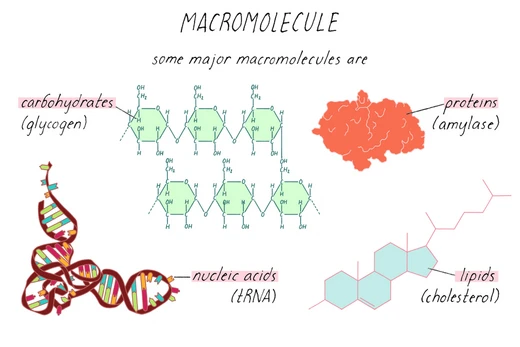
The macromolecule world divides neatly into two camps, and polyethylene sits firmly on the synthetic side. On the natural side, living organisms depend on three essential biopolymers — DNA, RNA, and proteins — each built from repeating monomers linked by covalent bonds into long, unbranched chains. Proteins fold into complex three-dimensional shapes because they are single-stranded and composed of twenty or more different amino acids, giving them binding pockets and catalytic ability. DNA, by contrast, is double-stranded and optimized for stable information storage, protected by sophisticated repair systems. RNA occupies a multifunctional middle ground, encoding genetic information and regulating protein synthesis. Polysaccharides like starch, cellulose, and chitin represent yet another natural class, built from monosaccharides joined by glycosidic bonds. Polyethylene, with its simple repeating olefin units and no biological function, stands in deliberate contrast: it is a human-made macromolecule whose value lies in material utility rather than biochemical catalysis or genetic encoding.
Frequently Asked Questions
Who is Polyethylene?
Polyethylene, often called polythene, is the highest-volume plastic manufactured on the planet. It sits in the polymer chemistry field and is most recognized as the go-to material for bags, films, containers, and insulation.
What are Polyethylene's main powers or strengths?
It is nontoxic, highly resistant to chemical attack, and extremely easy to process into films, bottles, and geomembranes. That chemical resilience is the core of its versatility across packaging and industrial applications.
What is Polyethylene's biggest weakness?
The very same chemical toughness that makes it useful means it resists natural breakdown, so improperly discarded PE persists in the environment as a long-lived pollutant. It is also combustible, which adds a fire-safety concern.
Why is Polyethylene considered the most important entry in the series?
It holds the record as the most commonly produced plastic worldwide, so its real-world footprint dwarfs every other polymer. Nearly everyone encounters it daily in grocery bags, wrap films, and household containers, making it the series' most universally recognized character.
How does Polyethylene's story end, and what is its legacy?
Its legacy is a double-edged one: it revolutionized packaging and insulation while simultaneously becoming one of the most persistent plastic pollutants in the environment. Fans often cite its arc as the clearest illustration of the tension between everyday utility and long-term ecological cost.
More in Polymers And Macromolecules 1-24
Elsewhere in the Polymers And Macromolecules universe
Spotted an error? Know more?
This is a living reference — every entry is fact-audited, and reader corrections feed straight into our audit queue. Suggest an edit · See this site's audit record